


1.Application Scenarios:
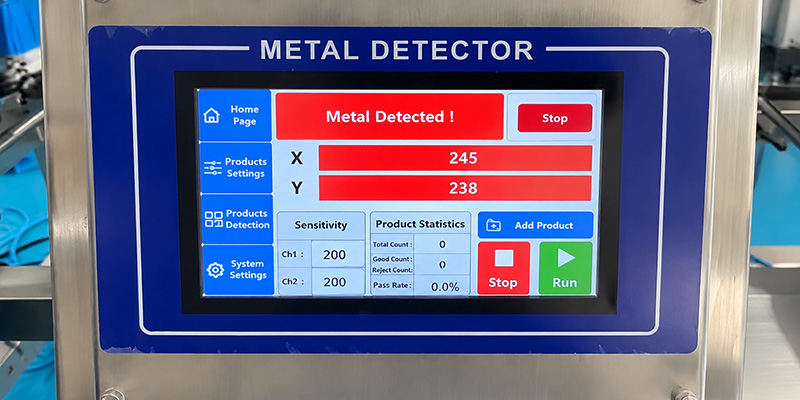
Metal detection is a common method for identifying metallic contaminants in prepared food products. For meals packed in ordinary plastic pouches or vacuum bags without metallic layers, a belt conveyor metal detector can inspect finished packages after filling and sealing.
Pre-prepared food products may contain meat, vegetables, sauces, or other ingredients, each with varying moisture and salt content. During the metal detection process, these product characteristics can create a "product effect," which may, in turn, impact detection performance.
HISTOM food metal detectors can be configured to inspect different prepared food products by considering their composition, dimensions, packaging materials, and production conditions.
The systems can detect ferrous metals, non-ferrous metals, and 304 stainless steel. Product effect learning helps the machine adapt to the electromagnetic characteristics of different food products, reducing the influence of product signals on metal detection.
During operation, each package passes through the detection aperture. If metal contamination is detected, the automatic rejection system removes the non-conforming package from the conveyor.
This solution is suitable for a wide range of chilled and frozen ready-to-eat food applications, provided that the packaging materials and product characteristics are compatible with the selected metal detection equipment. Actual detection performance should be verified through testing with product samples; we welcome the submission of samples for such evaluation.
For products packaged in aluminum foil or metallized film, conventional metal detection equipment may not be appropriate. Depending on the packaging structure and specific inspection requirements, manufacturers should consider alternative inspection methods, such as X-ray detection systems.
Empfohlenes Modell


1.Application Scenarios:
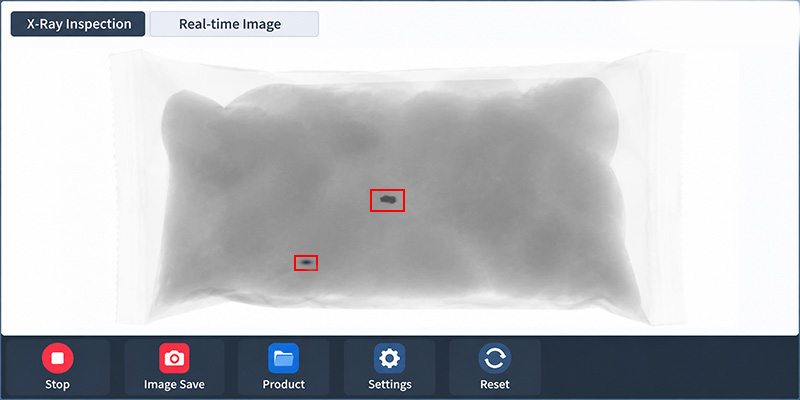
X-ray inspection for the food industry is an important approach to identifying foreign objects inside packaged products. Unlike conventional metal detectors, X-ray systems analyze differences in material density to identify detectable foreign materials.
For manufacturers of pre-prepared food products, X-ray inspection technology is a viable solution for items packaged in various types of flexible packaging—including plastic bags, vacuum pouches, aluminum foil bags, and metallized film packaging.
Depending on the nature of the foreign object, the characteristics of the product, and the specific inspection conditions, such systems can detect contaminants including metal, glass, stone, and ceramic.
2.X-Ray Inspection for Different Pouch Packaging Materials
One advantage of X-ray inspection is that it does not rely on the electromagnetic detection principle used by conventional metal detectors. This makes it a suitable option for prepared meals packed in aluminum foil or metallized film, where conventional metal detection may be affected by the packaging material.
During operation, the system analyzes each package and identifies potential foreign objects based on features in its X-ray image. Products deemed non-compliant can be automatically rejected from the production line.
For various types of prepared food products, the system can save inspection images to facilitate quality review and traceability. Furthermore, the system supports the storage of product recipes, which streamlines the process of switching between different products during production.
3.Cold Chain X-Ray Inspection for Refrigerated and Frozen Prepared Foods
For manufacturers handling chilled and frozen prepared meals, cold chain X-ray inspection can be considered as part of their packaged food quality control process.
Selecting the appropriate X-ray inspection equipment depends on factors such as product dimensions, packaging thickness, product density, and the specific requirements of the production line.
For products with varying packaging widths, lengths, and thicknesses, it may be necessary to configure specific conveyor systems and inspection solutions. Manufacturers should provide product samples or packaging dimensions so that the most suitable equipment model can be recommended and its inspection performance evaluated.
The actual inspection effectiveness should be verified through sample testing, which takes into account product density, packaging thickness, as well as the size and material of potential foreign objects.
Empfohlenes Modell
1.Application Scenarios
Foreign object detection is just one aspect of quality control for prepared food. Accurate product information is equally vital—especially for pre-packaged meals that require labeling with production dates, expiration dates, batch numbers, and other product details.
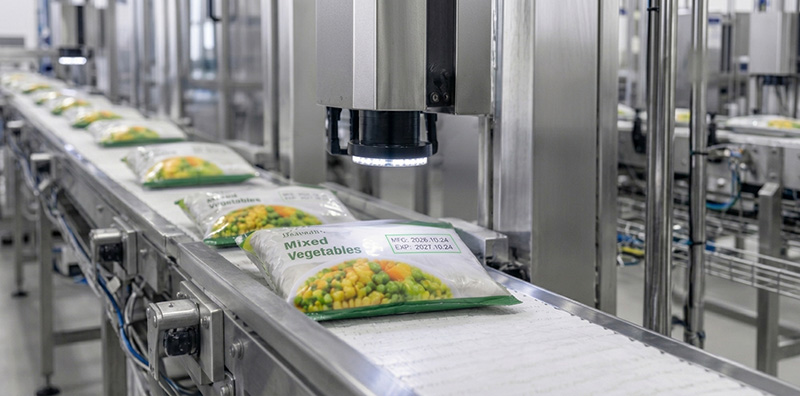
HISTOM uses industrial cameras and image recognition technology in its label vision inspection systems to inspect printed information and labels on flexible food packaging. These systems can check whether printed content is complete, clear, correctly positioned, and consistent with preset inspection requirements.
2.Production Date and Batch Code Inspection
During production, the vision system captures images of printed information on each package and checks the production date, expiry date, and batch number.
It can identify common printing defects, including:
● Missing characters or incomplete date codes
● Blurred, unclear, or distorted printing
● Incorrect dates or batch information
● Character displacement, misalignment, or tilted printing
In addition to checking print quality, the system can identify the characters actually printed and compare them against preset reference information. This helps detect incorrect dates, batch numbers, or other product information that does not match the specifications.
Label Recognition and Verification
In addition to verifying date codes, the vision system can also inspect the appearance and content of product labels.
The system is capable of detecting missing or incorrect labels, misaligned labels, and other predefined visual defects. Furthermore, it can read text on labels and compare it against stored product information to identify labeling errors.
For manufacturers producing a variety of pre-packaged food items, the system can store and retrieve specific inspection protocols tailored to different packaging designs, print layouts, and product information.
If a package fails to meet the inspection criteria, the system can trigger an alarm and—depending on the chosen configuration and production line requirements—activate an automated rejection mechanism.
This helps reduce the risk of product labeling errors and ensures greater consistency in packaging information.
Empfohlenes Modell
How to Choose the Right Inspection Equipment for Prepared Foods
The selection of prepared food inspection equipment mainly depends on packaging materials, potential foreign object risks, and packaging quality control requirements.
| Production Application | Recommended Equipment | Main Inspection Purpose | |
| Prepared meals in ordinary plastic pouches | Food Metal Detector | Inspect finished packages for metal contamination | |
| Prepared meals in aluminum foil or metallized film bags | Food X Ray Machine | Detect detectable foreign objects in metallic packaging | |
| Prepared meals requiring inspection for metal, glass, stones, or ceramics | Food X-Ray Machine | Identify detectable foreign materials based on density differences | |
| Pouch-packed meals requiring date and batch code verification | Vision Coding Inspection System | Identify missing, blurred, incorrect, or misaligned printed information | |
| Packages requiring label verification | Label Vision Inspection System | Check label presence, appearance, and configured label information | |
For production lines with multiple quality control requirements, different inspection systems can be combined.
For example:
● Plastic pouch packaging: Metal detection + vision coding inspection.
● Vacuum-packed prepared meals: Metal detection + vision coding inspection, provided the packaging contains no metallic layer.
● Aluminum foil or metallized film packaging: X-ray inspection + vision coding inspection.
● Comprehensive inspection requirements: Metal detection or X-ray inspection, selected according to packaging materials, combined with vision inspection for printed information.
The final configuration should be determined according to product samples, packaging materials, production speed, installation space, and inspection objectives.
Customized Prepared Food Inspection Solutions from HISTOM
Different prepared food products and packaging formats require different inspection configurations. HISTOM provides customized prepared food inspection solutions for manufacturers producing refrigerated, frozen, and other pouch-packed prepared foods.
Our engineering team can evaluate product composition, moisture content, packaging materials, package dimensions, and production line conditions to recommend the ideal metal detection systems, X-ray inspection equipment, and vision-based coding inspection systems for your needs.
Whether you require a standalone inspection unit or a comprehensive inspection solution, HISTOM empowers prepared-food manufacturers to enhance foreign object detection, verify packaging information, and strengthen quality control throughout the production process.
