


1.Application Scenarios
Metal detection is a method widely used to identify metal contaminants in finished baked goods. For bread packaged in standard plastic bags or non-metallic boxes, appropriate food-grade metal detection equipment can be installed after the packaging stage, allowing for inspection before the products enter storage or distribution.
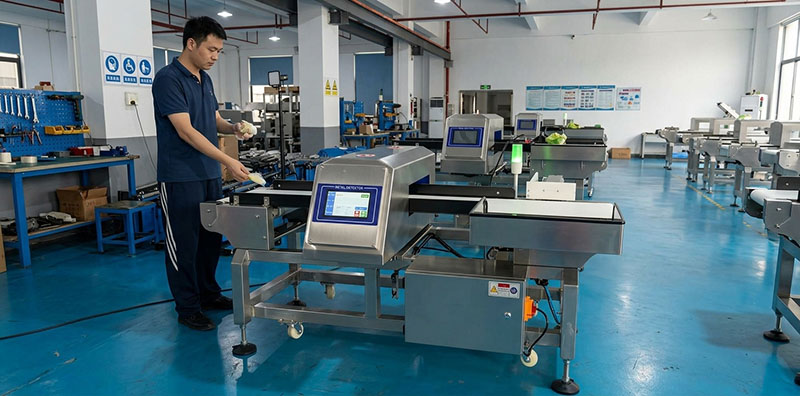
A metal detector for bread helps manufacturers identify ferrous metals, non-ferrous metals, and stainless steel that may enter products during processing. A belt conveyor metal detector transports individual packages through the detection aperture and inspects them for metallic contamination. When metal is detected, the configured automatic rejection mechanism removes the affected package from the production line.
2.Metal Detection for Bagged Bread
Bagged bread products, such as sliced bread, sandwich loaves, hamburger buns, and bread rolls, are commonly packed in flexible plastic packaging.
metal detector can inspect each finished package after sealing. When metallic contamination is identified, an automatic rejection mechanism can separate the affected package from accepted products, helping manufacturers maintain consistent quality control.
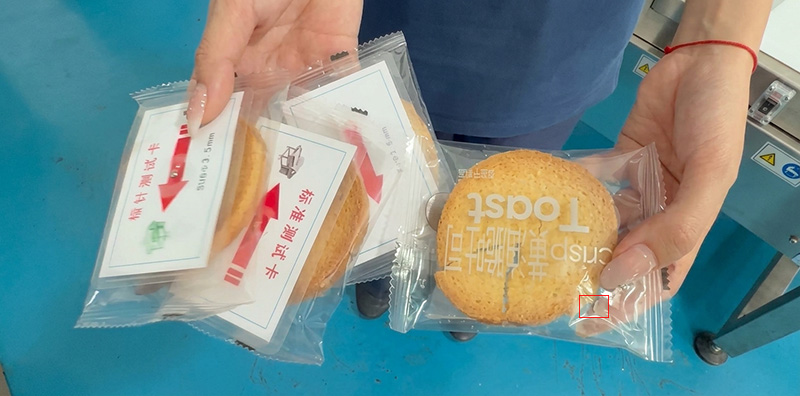
HISTOM has conducted practical sample testing on bagged and boxed bread products. Commonly used metal test specimens include 1.0 mm ferrous test cards and 2.5 mm stainless steel sphere test cards. These specimens can be used to demonstrate detection performance during the product testing process.
Actual detection sensitivity depends on the bread product itself, packaging dimensions, product orientation, and operating conditions. It is recommended that manufacturers provide representative samples so that detection performance can be evaluated prior to purchasing equipment.
3.Metal Detection for Boxed Bread
Some bread products are packaged in cardboard boxes or other non-metallic containers for retail display and protection.
When the packaging materials and product characteristics allow, metal detection technology can also be applied to boxed bread. This inspection system screens finished, packaged products for metallic foreign objects, enabling manufacturers to maintain a consistent inspection process across various packaging formats.
For bakeries that produce both bagged and boxed bread, the same inspection technology can be applied to both types of packaging; however, the dimensions of the inspection aperture and the operating parameters must be determined based on the specific packaging dimensions and the results of tests using representative samples.
4.Understanding Metal Detector Sensitivity in the Food Industry
Metal detector sensitivity in the food industry is an important consideration when selecting inspection equipment. However, sensitivity is not determined by the machine alone. Product characteristics, package dimensions, aperture size, product effect, and operating conditions can all influence the achievable detection performance.
Bread products vary in terms of moisture content, salt content, density, and structure—characteristics that can influence the signals generated during metal detection. Through an "automatic product effect learning" function, the system can adapt to these varying product characteristics, thereby minimizing interference from the products themselves during the inspection process.
Consequently, manufacturers should evaluate the sensitivity of their metal detection equipment using representative bread samples and appropriate test pieces under actual or simulated production conditions. Test results are specific to the particular product and equipment configuration and should not be interpreted as a universal guarantee of detection capability.
For packaging that contains aluminum foil or a metallized layer, conventional metal detection methods may not be suitable. In such cases, manufacturers should consider employing X-ray inspection or other appropriate detection technologies.
Empfohlenes Modell


Metal Detectors or X-ray Inspection Systems: Which Is Better for Your Bakery Production Line?
Choosing between metal detection and X-ray inspection depends on the common foreign object risks associated with your food products, as well as the characteristics of their packaging.
| Inspection Consideration | Metal Detector | X-Ray Inspection Machine | |
| Main detection targets | Ferrous, non-ferrous, and stainless steel | Metals, glass, stones, and ceramics | |
| Suitable packaging | Plastic bags and non-metallic boxes | Plastic bags, boxes, and selected metallized packaging | |
| Powder in plastic bottles or metal cans | Side-Illuminated X-Ray Inspection Machine | Detect detectable foreign objects inside containers | |
| Best suited for | Metal contamination control | Broader foreign object inspection | |
For bakery businesses primarily concerned with metal contamination, a conveyor-style metal detector is a practical choice for packaged finished bread products. If there is also a need to detect non-metallic foreign objects, an X-ray inspection system may be a more suitable solution.
For manufacturers with broader inspection requirements, these two technologies can be used as complementary systems. The final choice should be determined based on product characteristics, packaging materials, and the results of sample testing.
Where Should Inspection Equipment Be Installed in a Bakery Production Line?
For most packaged bread applications, final inspection is commonly arranged after the product has been packed. This allows manufacturers to inspect finished packages before they move into storage, case packing, or distribution.
A typical inspection arrangement may follow this sequence:
● Bread processing: Mixing, dough preparation, dividing, forming, and baking.
● Cooling and slicing: Bread is cooled and sliced when required, with equipment condition checked regularly.
● Packaging: Products are packed using plastic bags, cartons, or other selected packaging formats.
● Final Inspection: Once packaged, products must be inspected—in accordance with specific testing requirements—using a metal detector or an X-ray inspection system.
● Rejection: Products deemed non-compliant are automatically separated from compliant items by a pre-configured rejection mechanism.
When determining the installation location, factors such as product spacing, production speed, available floor space, and downstream equipment must be taken into account.
If there is a risk of contamination at multiple stages of the processing line, manufacturers may also consider incorporating additional inspection steps or preventive control points prior to final packaging.
Building a Reliable Foreign Object Control Plan for Bakeries
Inspection equipment is most effective when integrated with foundational preventive control measures implemented throughout the entire production process.
● Inspect raw materials: Examine flour, grains, seeds, nuts, and other ingredients before use. For detecting foreign objects in bulk materials, we recommend specialized Bulk Food Material X-ray Inspection Machine.
● Maintain equipment: Regularly check mixers, conveyor belts, and slicing blades for signs of wear or damage.
● Verify inspection systems: Periodically test detection and rejection functions to ensure they are operating correctly.
● Manage rejected products: Isolate rejected items, investigate the root cause, and maintain thorough inspection records.
● Combining these measures with final product inspection helps bakery businesses reduce the risk of foreign object contamination and maintain consistent quality control.
Customized Bakery Inspection Solutions from HISTOM
Different bread products and packaging formats require different inspection configurations. HISTOM provides customized bakery product inspection solutions for manufacturers producing bagged bread, boxed bread, and other packaged bakery products.
Our metal detection systems can be evaluated for ordinary plastic bags and non-metallic packaging boxes, helping identify ferrous, non-ferrous, and stainless steel contaminants. For manufacturers requiring additional inspection for glass, stones, ceramics, and other detectable foreign materials, our food X-ray inspection systems can be considered according to the product and packaging conditions.
Our team can conduct assessments covering the following areas:
1.Bread types and product dimensions
2.Packaging materials (bags or boxes)
3.Package dimensions (length, width, and height)
4.Production speed and conveyor system requirements
5.Types and sizes of potential foreign contaminants
6.Required rejection and inspection functionalities
For clients who wish to evaluate the inspection process prior to purchase, HISTOM can provide sample inspection videos for bagged or boxed bread products. You may also send us product samples so that we can verify whether the proposed inspection configuration is suitable for your needs.
From standalone metal detectors to integrated, multi-stage inspection systems, HISTOM helps bakeries select the optimal equipment tailored to their specific production requirements and food safety standards.
1.Application Scenarios
Metal detection is primarily designed to identify metallic contaminants. However, bakeries may also need to control other foreign materials that cannot be identified by conventional metal detection.
X-ray inspection for bakery products provides another inspection option. It uses differences in X-ray absorption and image characteristics between the product and foreign materials to identify detectable contaminants inside packaged bread.
Depending on material density, foreign object size, product thickness, and inspection conditions, an X-ray system can be used to detect contaminants such as:
● Metal fragments
● Glass fragments
● Stones
● Ceramic fragments
Therefore, for manufacturers looking to manage foreign object contamination more comprehensively—beyond just metal contaminants—X-ray inspection is an effective solution.
2.X-Ray Inspection for Bagged and Boxed Bread
X-ray inspection technology can be applied to bagged and boxed bakery products, including sliced bread, sandwich bread, rolls, and various other types of packaged baked goods.
Unlike traditional metal detection, which relies on electromagnetic induction, X-ray inspection does not. Consequently, it is suitable for a wide range of packaging materials, including standard plastic bags, paper cartons, and certain types of metallized packaging.
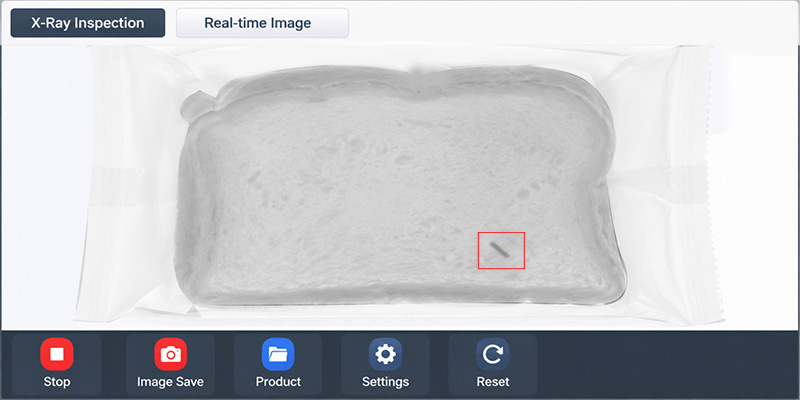
During the inspection process, the system analyzes the X-ray image of each product, identifying potential foreign objects based on image characteristics. If a non-compliant product is detected, an automatic rejection mechanism removes it from the production line.
For bakery products containing ingredients such as nuts, seeds, chocolate chips, or other inclusions, inspection parameters can be optimized—based on product recipes and sample testing—to minimize false rejections caused by these intended ingredients.
X-ray radiation poses no harm to the products themselves, nor does it affect the taste or quality of the food.
3.X-Ray Inspection for Cakes and Other Bakery Products
In addition to bread, X-ray inspection can also be applied to various types of cakes, pastries, and other packaged bakery products.
Bakery products vary significantly in terms of their structure, composition, and density. For instance, items containing nuts, seeds, chocolate, fillings, or multi-layered components may require specific inspection parameter settings.
Therefore, the most suitable inspection solution should be determined through product sample testing, taking into account factors such as product dimensions, packaging materials, and the types of foreign objects that need to be controlled.
Empfohlenes Modell
Metal Detectors or X-ray Inspection Systems: Which Is Better for Your Bakery Production Line?
Choosing between metal detection and X-ray inspection depends on the common foreign object risks associated with your food products, as well as the characteristics of their packaging.
| Inspection Consideration | Metal Detector | X-Ray Inspection Machine | |
| Main detection targets | Ferrous, non-ferrous, and stainless steel | Metals, glass, stones, and ceramics | |
| Suitable packaging | Plastic bags and non-metallic boxes | Plastic bags, boxes, and selected metallized packaging | |
| Powder in plastic bottles or metal cans | Side-Illuminated X-Ray Inspection Machine | Detect detectable foreign objects inside containers | |
| Best suited for | Metal contamination control | Broader foreign object inspection | |
For bakery businesses primarily concerned with metal contamination, a conveyor-style metal detector is a practical choice for packaged finished bread products. If there is also a need to detect non-metallic foreign objects, an X-ray inspection system may be a more suitable solution.
For manufacturers with broader inspection requirements, these two technologies can be used as complementary systems. The final choice should be determined based on product characteristics, packaging materials, and the results of sample testing.
Where Should Inspection Equipment Be Installed in a Bakery Production Line?
For most packaged bread applications, final inspection is commonly arranged after the product has been packed. This allows manufacturers to inspect finished packages before they move into storage, case packing, or distribution.
A typical inspection arrangement may follow this sequence:
● Bread processing: Mixing, dough preparation, dividing, forming, and baking.
● Cooling and slicing: Bread is cooled and sliced when required, with equipment condition checked regularly.
● Packaging: Products are packed using plastic bags, cartons, or other selected packaging formats.
● Final Inspection: Once packaged, products must be inspected—in accordance with specific testing requirements—using a metal detector or an X-ray inspection system.
● Rejection: Products deemed non-compliant are automatically separated from compliant items by a pre-configured rejection mechanism.
When determining the installation location, factors such as product spacing, production speed, available floor space, and downstream equipment must be taken into account.
If there is a risk of contamination at multiple stages of the processing line, manufacturers may also consider incorporating additional inspection steps or preventive control points prior to final packaging.
Building a Reliable Foreign Object Control Plan for Bakeries
Inspection equipment is most effective when integrated with foundational preventive control measures implemented throughout the entire production process.
● Inspect raw materials: Examine flour, grains, seeds, nuts, and other ingredients before use. For detecting foreign objects in bulk materials, we recommend specialized X-ray inspection systems designed for bulk food products.
● Maintain equipment: Regularly check mixers, conveyor belts, and slicing blades for signs of wear or damage.
● Verify inspection systems: Periodically test detection and rejection functions to ensure they are operating correctly.
● Manage rejected products: Isolate rejected items, investigate the root cause, and maintain thorough inspection records.
● Combining these measures with final product inspection helps bakery businesses reduce the risk of foreign object contamination and maintain consistent quality control.
Customized Bakery Inspection Solutions from HISTOM
Different bread products and packaging formats require different inspection configurations. HISTOM provides customized bakery product inspection solutions for manufacturers producing bagged bread, boxed bread, and other packaged bakery products.
Our metal detection systems can be evaluated for ordinary plastic bags and non-metallic packaging boxes, helping identify ferrous, non-ferrous, and stainless steel contaminants. For manufacturers requiring additional inspection for glass, stones, ceramics, and other detectable foreign materials, our food X-ray inspection systems can be considered according to the product and packaging conditions.
Our team can conduct assessments covering the following areas:
1.Bread types and product dimensions
2.Packaging materials (bags or boxes)
3.Package dimensions (length, width, and height)
4.Production speed and conveyor system requirements
5.Types and sizes of potential foreign contaminants
6.Required rejection and inspection functionalities
For clients who wish to evaluate the inspection process prior to purchase, HISTOM can provide sample inspection videos for bagged or boxed bread products. You may also send us product samples so that we can verify whether the proposed inspection configuration is suitable for your needs.
From standalone metal detectors to integrated, multi-stage inspection systems, HISTOM helps bakeries select the optimal equipment tailored to their specific production requirements and food safety standards.
